
PTE Reading and Writing Fill in the Blanks là phần thi nhằm kiểm tra kỹ năng đọc hiểu và vốn từ vựng của thí sinh. Nắm rõ cấu trúc bài thi PTE Reading And Writing Fill In The Blanks giúp thí sinh biết cách sắp xếp thời gian và có chiến thuật làm bài hiệu quả hơn. Cùng PTE Life tìm hiểu chi tiết về phần thi này trong bài viết dưới đây!
Cấu trúc bài thi PTE Reading and Writing Fill in the blanks
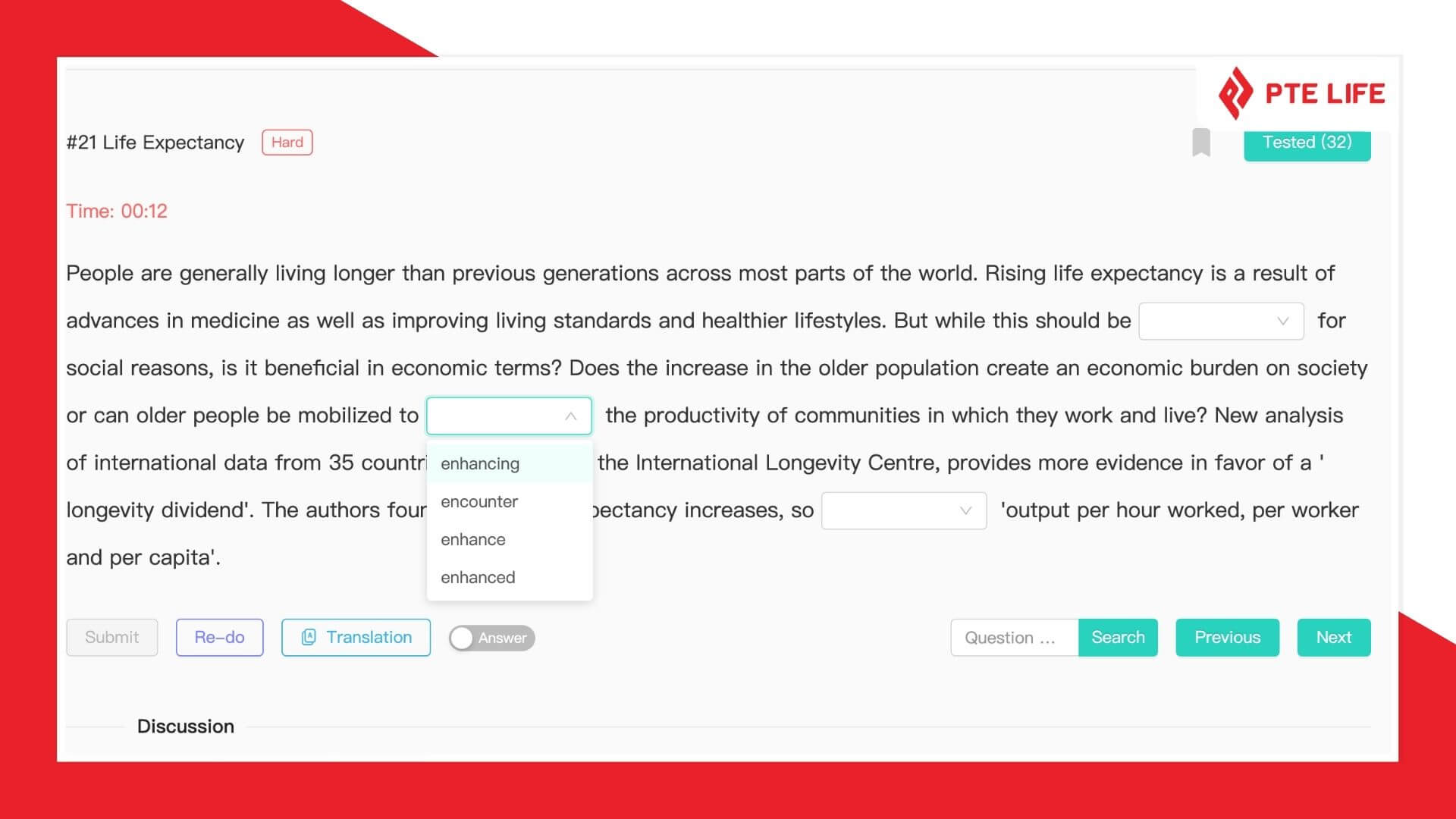
PTE Reading and Writing Fill in the Blanks là dạng bài điền từ vào chỗ trống, xuất hiện đầu tiên trong phần thi Reading. Dạng bài này kiểm tra khả năng đọc hiểu, vốn từ vựng và ngữ pháp của thí sinh.
- Yêu cầu đề bài: Thí sinh sẽ nhận được một đoạn văn có 3-4 chỗ trống. Mỗi chỗ trống đi kèm với 4 phương án lựa chọn. Nhiệm vụ của thí sinh là chọn từ phù hợp nhất để hoàn thiện đoạn văn một cách chính xác và tự nhiên.
- Số lượng câu hỏi: 5-6 câu trong một bài thi.
Dạng bài này không có giới hạn thời gian riêng mà sử dụng chung quỹ thời gian của phần Reading. Do đó, thí sinh cần quản lý thời gian hiệu quả để đảm bảo hoàn thành tất cả các câu hỏi.
Vì dạng bài này không có mẹo làm cố định, nên cách duy nhất để cải thiện điểm số là luyện tập đều đặn. Càng luyện nhiều, bạn sẽ càng làm tốt hơn!
Cấu trúc bài thi PTE Reading and Writing Fill in the blanks
4 Lỗi sai thường gặp khiến bạn “mắc kẹt” điểm
Một số lỗi sai thường gặp khiến bạn dễ bị mất điểm khi làm bài PTE Reading and Writing Fill in the Blanks đó là: chọn sai loại từ, đa nghi quá đà, quản lý thời gian kém và bỏ qua đáp án. Cụ thể cách khắc phục các lỗi trên như sau:
Chọn sai loại từ
Nếu không nắm vững ngữ pháp và từ vựng, bạn sẽ dễ bị phân vân giữa các dạng từ loại, dẫn đến chọn sai loại từ.
Ví dụ: She has a strong (decision/decisive/decide) skill in management. Đáp án đúng là “decisive” vì cần một tính từ để bổ nghĩa cho “skill”.
Để khắc phục lỗi này, bạn cần nắm chắc cách sử dụng các loại từ cơ bản như danh từ, động từ, tính từ, trạng từ… để đưa ra lựa chọn chính xác nhất.
Đa nghi quá đà
Nhiều thí sinh chọn đúng đáp án ngay từ đầu, nhưng sau đó lại thay đổi vì nghĩ rằng đề không thể dễ hoặc hiển nhiên đến vậy. Dù R&W FIB là một phần thi “hack não”, vẫn có những câu dễ bất ngờ giúp bạn gỡ điểm. Vì thế, hãy tin vào lựa chọn của bản thân, tránh phân vân quá lâu! Nếu cảm thấy đáp án hợp lý, hãy giữ nguyên thay vì đổi đi đổi lại.

Lỗi sai thường gặp khi làm bài PTE Reading and Writing Fill in the Blanks
Không quản lý tốt thời gian
Thời gian làm R&W FIB nằm trong 30 phút của toàn bộ phần thi Reading, chứ không có khung riêng, và đây lại là phần đầu tiên. Nếu dành quá nhiều thời gian cho từng câu, bạn sẽ bị thiếu thời gian cho các dạng bài tiếp theo.
Bạn nên lưu ý: không nên dành quá 2 phút/câu. Hãy tập “buông bỏ” để có thể phân bổ cơ hội ăn điểm đồng đều hơn. Khi gặp câu khó, chọn nhanh đáp án tiềm năng rồi chuyển sang câu tiếp theo.
Bỏ qua đáp án
Nhiều thí sinh không chọn đáp án khi không chắc chắn vì sợ sai. Tuy nhiên, bạn nên nhớ, trong bài thi PTE, đáp án đúng sẽ có điểm và đáp án sai không bị trừ điểm. Vì vậy, không bao giờ được để trống câu trả lời. Nếu không biết đáp án, hãy chọn bừa vì bạn vẫn có 25% cơ hội đúng!
Thực hành với 10 câu R&W Fill in the blanks khó nhằn
Để có thể chinh phục dạng bài này, bạn cần dành nhiều thời gian luyện tập, đồng thời tự nâng cao vốn từ vựng, ngữ pháp của bản thân. Dưới đây là 10 câu R&W FIB có đáp án để bạn luyện tập ngay!
Câu 1:
People are generally living longer than previous generations across most parts of the world. Rising life expectancy is a result of advances in medicine as well as improving living standards and healthier lifestyles. But while this should be ___ (1) for social reasons, is it beneficial in economic terms? Does the increase in the older population create an economic burden on society or can older people be mobilized to ___ (2) the productivity of communities in which they work and live? New analysis of international data from 35 countries, published by the International Longevity Centre, provides more evidence in favor of a ‘longevity dividend’. The authors found that as life expectancy increases, so ___ (3) ‘output per hour worked, per worker and per capita’.
Choices:
- Celebrated, Cerebrates, Coordinating, Cerebrating
- Enhancing, Encounter, Enhance, Enhanced
- Does, Doing, Did, Done
Câu 2:
The economic ___ (1) of globalization involves international financial institutions i.e. the IMF & WB. Stabilization and adjustment are sponsored by the two respectively and are rooted in the ideology of the free market. At the other end of the spectrum, protesters see globalization in a very different light than the treasury secretary of the United States, or the finance or trade ministers of most of the advanced industrial countries. The difference in ___ (2) is so great that one wonders, are the protesters and the policy makers talking about the same ___ (3)? Are they looking at the same data? Are the visions of those in ___ (4) so clouded by special and particular ___ (5)?
Choices:
- Demonstration, Definition, Dimension, Depression
- Views, Exception, Expectation, Conclusion
- Substance, Phenomenon, Philosophy, Explanation
- Tandem, Powder, Conjugation, Power
- Interest, Efforts, Achievements, Detestation
Câu 3:
One cause of unemployment may be downswings in the trade cycle, i.e. periods of recession. Another explanation of wide-scale unemployment refers to ___ (1) (Answer: structural) unemployment. Structural unemployment arises from longer-term changes in the economy, affecting ___ (2) industries, regions and occupations. Structural unemployment often explains regional unemployment. Some regions of the UK such as Central Scotland, and the North-West have higher rates of unemployment because the ___ (3) heavy industries which ___ (4) there have gone into decline as they are ___ (5) by cheaper imports from abroad. The new high-tech industries based on new technologies tend to be based in the South-East and along particular growth corridors.
Choices:
- structural, regional, perpetual, temporary
- concrete, special, specific, infinite
- provisional, traditional, rational, exceptional
- lied, settled, located, built
- substituted, replaced, used, affected
Câu 4:
As demand for food and competition for land rises, it is vital that crop losses are ___ (1). Chemical protection has provided effective control of crop losses in recent years. Alongside chemical fertilizers and improved crop genetics, it has helped to increase crop yields dramatically over the last six decades. ___ (2), there is now a need to develop complementary alternatives, and researchers from the Rural Economy and Land Use Program have been exploring the potential of — and barriers to — alternative pest management approaches. ‘Alternatives to chemical pesticides are ___ (3) because overuse of them leads to pesticide resistance and affects biodiversity and water quality,’ says Dr Alastair Bailey. ‘Heightened EU regulations are also leading to the withdrawal of many pesticide products. ___ (4), complementary approaches are required to reduce use and preserve the efficacy of those valuable pesticides that are still available to sustain food production systems.
Choices:
- harnessed, utilized, limited, calculated
- Hopefully, However, Strangely, Therefore
- overshot, expired, needed, engaged
- Though, Yet, Hence, But
Câu 5:
Learning to write well in college means learning (or re-learning) how to write clearly and plainly. Now that doesn’t mean that plainness is the only good style, or that you should become a ___ (1) to spare, unadorned writing. Formality and ornateness have their place, and in ___ (2) hands complexity can take us on a dizzying, breathtaking journey. But most students, most of the time should ___ (3) to be sensibly simple to develop a baseline style of short words, active verbs and relatively simple sentences ___ (4) clear actions or identities. It’s faster, it makes arguments easier to follow, it increases the chances a busy reader will bother to pay attention, and it lets you ___ (5) more attention on your moments of rhetorical flourish which I do not advise abandoning altogether.
Choices:
- solder, person, staff, slave
- helping, competent, comparative, heaving
- commit, reject, endeavor, stick
- concealing, carrying, defining, confining
- rise, center, pin, span
Câu 6:
A spokesman for the project said: “A car mechanic for ___ (1) could find at a glance where a part on a certain car model is so that it can be identified and repaired. For the motorist the system could ___ (2) accident black spots or dangers on the road.”
In other cases the glasses could be worn by people going on a guided tour, ___ (3) points of interest or by people looking at panoramas where all the sites could be identified.
Choices:
Instance, indicating, highlight, complicated, successful, frustrating
Câu 7:
The ___ (1) decades of an artist’ s life do not generally make the biographer’ s heart beat faster, but Claude Monet is one of a handful of painters who bucks the pattern of an ___(2) old age. While it’s true that by the time he was 73 he had ___ (3) all the usual dragging baggage – outhouses full of fancy cars, a taste for expensive wine and a sprawl of dependents – it was also now that he produced career-defining work.
Choices:
Accumulated, inspired, early, irrelevant, closing, missing
Câu 8:
Critical thinking involves looking at something you may have seen many times and examining it from many different ___ (1) and perspectives. It involves going beyond the ___ (2) or beyond ‘easy’ to seek new understanding and rare ___ (3). It involves looking at common issues with uncommon eyes, known problems with new skepticism, everyday conflicts with probing ___ (4) and daily challenges with greater attention to detail.
Choices:
Curiosity, solutions, oblivious, caution, functions, angles, consequences, obvious
Câu 9:
Plants serve as the conduit of energy into the biosphere, provide food and materials used by humans, and they ___ (1) our environment. According to Ehrhardt and Frommer, the three major challenges facing humanity in our time are food, energy, and environmental ___ (2). All three are plant related. All of our food is produced by plants, either directly or indirectly via animals that eat them. Plants are a ___ (3) of energy production. And they are intimately involved in climate change and a major factor in a variety of environmental concerns, including agricultural expansion and its impact on habitat destruction and waterway pollution.
Choices:
Degradation, source, liaison, conduct, derivation, shape
Câu 10:
Since the beginning of the financial crisis, there have been two principal ___ (1) for why so many banks made such disastrous decisions. The first is structural. Regulators did not regulate. Institutions failed to ___ (2) as they should. Rules and guidelines were either inadequate or ignored. The second explanation is that Wall Street was ___ (3), that the traders and investors didn’t know enough, that they made extravagant bets without ___ (4) the consequences.
Choices:
- explanations, debates, excuses, examples
- function, use, stabilize, maintain
- rough, rampant, incompetent, irresponsible
- counting, understanding, correcting, valuing
Đáp án:
| Câu 1: 1. Celebrated 2. Enhance 3. Does | Câu 6: 1. instance 2. Highlight 3. indicating |
| Câu 2: 1. Dimension 2. Views 3. Phenomenon 4. Power 5. Interest | Câu 7: 1. closing 2. irrelevant 3. accumulated |
| Câu 3: 1. Structural 2. Specific 3. Traditional 4. Located 5. Replaced | Câu 8: 1. angles 2. obvious 3. solutions 4. curiosity |
| Câu 4: 1. Limited 2. However 3. Needed 4. Hence | Câu 9: 1. shape 2. degradation 3. source |
| Câu 5: 1. Slave 2. Competent 3. Endeavor 4. Carrying 5. Center | Câu 10: 1. explanations 2. function 3. incompetent 4. understanding |
Trên đây là những thông tin cơ bản về cấu trúc bài thi PTE Reading And Writing Fill In The Blanks mà PTE Life đã chia sẻ đến bạn. Để chinh phục dạng bài này, hãy dành thời gian luyện tập thường xuyên và bồi đắp thêm từ vựng, ngữ pháp mỗi ngày nhé!